Biography
Marco Hening Tallarico
Marco Hening Tallarico is a Brazilian-Italian-Canadian writer and researcher working in data science, applied machine learning, and statistical modeling. His research focuses on time-series analysis, masked autoencoders, and weather derivatives, with an interest in how machine-learning systems adapt across regimes, uncertainty, and noisy real-world data.
He is currently affiliated with Risklab and the University of Toronto, where he is a graduate student in Statistics. He previously completed a BSc in Mathematics, with a specialization in Computer Science and a minor in Economics, at Toronto Metropolitan University. His undergraduate thesis, supervised by Professor Pablo Olivares, was titled “Neural Network Approaches to Pricing Weather Derivatives.” Their later paper, “Neural and Time-Series Approaches for Pricing Weather Derivatives: Performance and Regime Adaptation Using Satellite Data,” extended this work.


Born in Belo Horizonte, Brazil, Tallarico spent his early childhood in Florianópolis and Rio de Janeiro before moving to Vancouver at nine and Toronto at thirteen. Portuguese was his first language; English became the one in which he now mostly writes. His background crosses technical research, literary writing, and combat sports: he studied Latin, piano, mathematics, and computer science, boxed for more than five years, and grew up around Brazilian jiu-jitsu through his father, Mario Claudio Tallarico, who received a black belt from Rolls Gracie in 1978 and won the Brazilian National Freestyle Wrestling Championship the same year.
Tallarico writes about machine learning, statistics, and data science for venues including Towards Data Science, AI Advances, and arXiv. His work ranges from technical research to essays that connect mathematical methods with broader questions of risk, interpretation, and scientific storytelling.




Papers:
Neural and Time-Series Approaches for Pricing Weather Derivatives: Performance and Regime Adaptation Using Satellite Data
Marco Hening Tallarico, Pablo Olivares


Research
MSc. Statistics | University of Toronto (UofT)
Research Project: “Multimodal Time-Series Transformers for Rare Health Event Prediction”
MSc. Supervisor: Luis Seco
Coming Soon
BSc. Mathematics — Computer Science Option | Toronto Metropolitan University (TMU)
Thesis: “Neural Network Approaches to Pricing Weather Derivatives”
Supervisor: Pablo Olivares
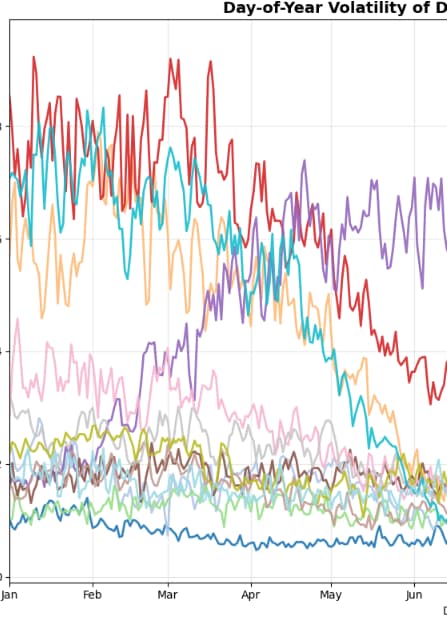
Developed machine learning and statistical models for pricing temperature- and precipitation-linked weather derivatives using 1981–2023 NASA POWER satellite climate data for Toronto and Chicago. Benchmarked harmonic regression and ARMA models against a lag-augmented feed-forward neural network for one-month-ahead temperature forecasting, with the neural model reducing forecast error and materially changing strangle contract valuations. For precipitation, implemented a compound Poisson–Gamma pricing framework and trained a 1D CNN on rainfall sequences to estimate season-adaptive Gamma parameters, capturing regime heterogeneity that static i.i.d. models miss. Connected forecasting outputs directly to financial payoff models through analytical pricing formulas and Monte Carlo simulation.

Articles
I write technical essays for Towards Data Science on machine learning, data science, and mathematical modelling. My work focuses on making rigorous methods usable: rare-event forecasting with transformers, data leakage and validation design, climate-data pipelines, physics-informed neural networks, mathematical foundations of AI, and scientific applications of ML. Selected articles are also cross-posted on Medium.

Sample Topics
Rare-Event Solar Flare Forecasting with Transformers
Explained how transformer architectures can be adapted for rare-event forecasting by combining classification objectives with tail-risk modeling. The article uses solar flare prediction to show why accuracy fails under severe class imbalance and how tail-aware heads can estimate both event probability and extreme-event severity.
NASA Climate Data Engineering and Analysis
Built a Python workflow for accessing NASA POWER climate data, structuring multi-location climate variables, and analyzing warming trends with anomaly plots and regression. The article connects climate data pipelines to applications in agriculture, renewable energy, sustainable buildings, and climate-risk monitoring.
Physics-Informed Neural Networks for Inverse PDEs
Implemented a PINN in DeepXDE to solve an inverse heat-equation problem, estimating thermal diffusivity and heat-source parameters from simulated temperature observations. The article demonstrates how automatic differentiation and physics-based residual losses can improve scientific machine learning.
Data Leakage Challenge for Machine Learning Validation
Created a hands-on challenge showing how leakage enters ML workflows through post-event variables, identifiers, temporal splits, and preprocessing decisions. The article emphasizes prediction-time availability, group-aware validation, and train-only preprocessing as safeguards against inflated model performance.
Pictures